The Value of Play: How Wiping a Canvas Led to a Studio Breakthrough
There is a distinct kind of pressure that comes with staring at a canvas. We want every session to be productive, every stroke to be intentional, and every piece to match our style. But lately, I’ve been reminded that the real breakthroughs don’t happen when we are trying to paint a masterpiece—they happen when we give ourselves permission to just play.
This week, a moment of frustration in the studio turned into one of the most refreshing sessions I’ve had in a while, resulting in a mini-series of four small paintings.
The rule for these pieces? No expectations.
Finding the Horizon in a Wiped Canvas
It all started because I was staring at a few small studies that just weren't working. They felt muddy, linear, and completely out of sync with where I wanted to go. Out of frustration, I grabbed a rag and started wiping them down to clear the slate.
But as I was scrubbing the wet paint away, something interesting happened. The rag left behind these beautiful, blurred, organic masses. I started playing with the cloth—stamping shapes, pulling light out of the dark, and using the remnants of old paint to hint at lakes and foliage.
Instead of starting over, I decided to see where the play would take me across four different canvases.
The Evolution of the Play Session
Each of these four small works became a stepping stone, teaching me how to balance the soft, atmospheric tones of a rag wipe with the deliberate structure of a brush.
1. Intuitive Reaction (Crimson Lake in August)
This was the first experiment. I leaned entirely into the leftover paint on my palette, mixing rich reds and yellow ocres. As I played with the rag, I realized the scene lacked depth. I introduced Mars Black to firmly push the foreground foliage forward, then spent time harmonizing the heavy darks with hints of the remaining warm colors.
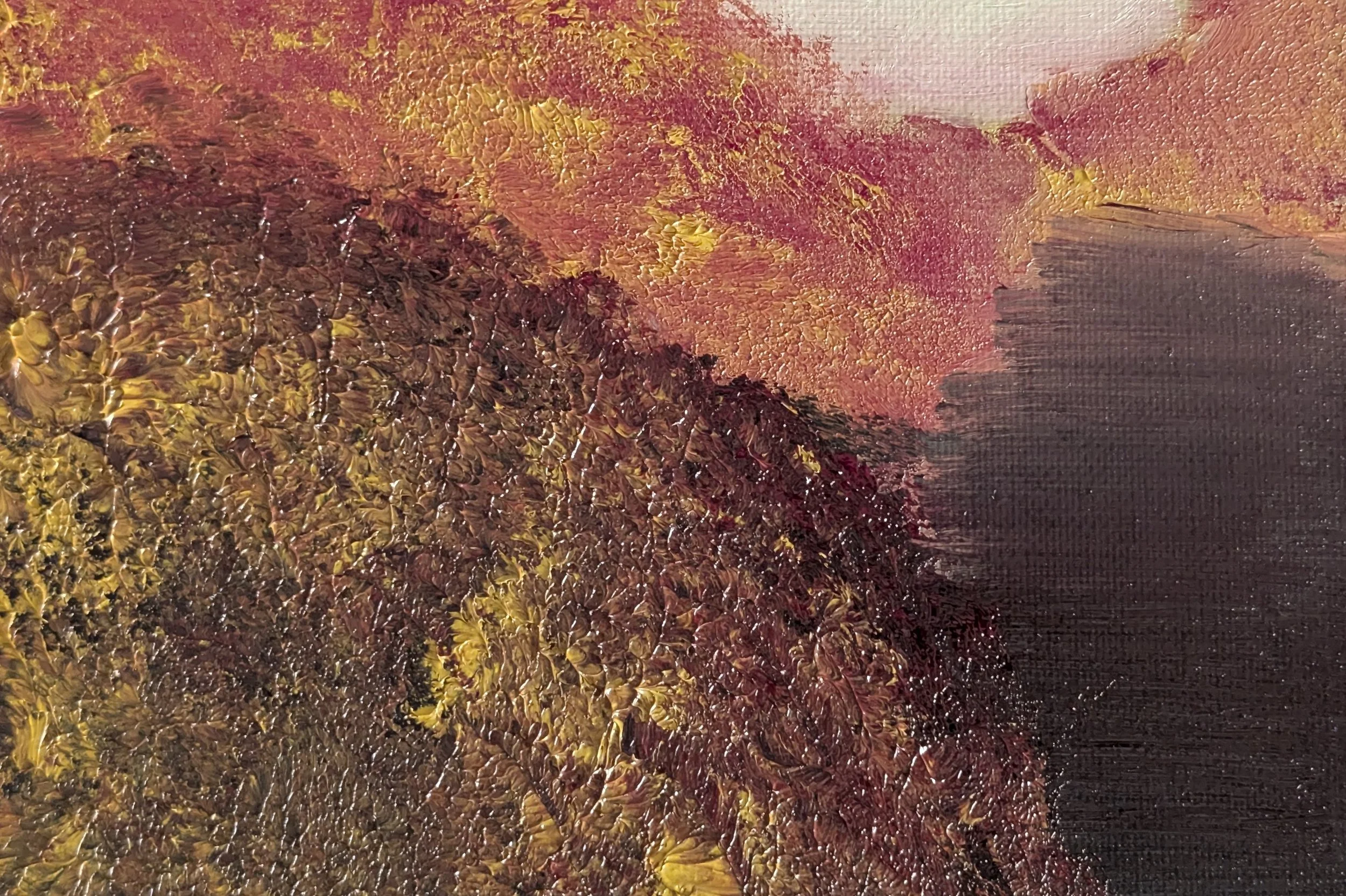
Born from leftover palette paint, this piece was a lesson in values and how to use texture to draw shapes forward.
2. Wrestling with the Baggage (The Crimson and Grey Clearing)
This canvas had the most history—it was a partially dried, light grey piece that looked incredibly muddy and linear. I tried adding palette knife accents, but it wasn’t working. I took the rag and completely blurred the hard lines, stamping in new shapes as the paint evolved. After introducing Payne's Grey, Alizarin Crimson, and Cadmium Red, I used the cloth to literally carve a path right through the heavy woods I’d created.
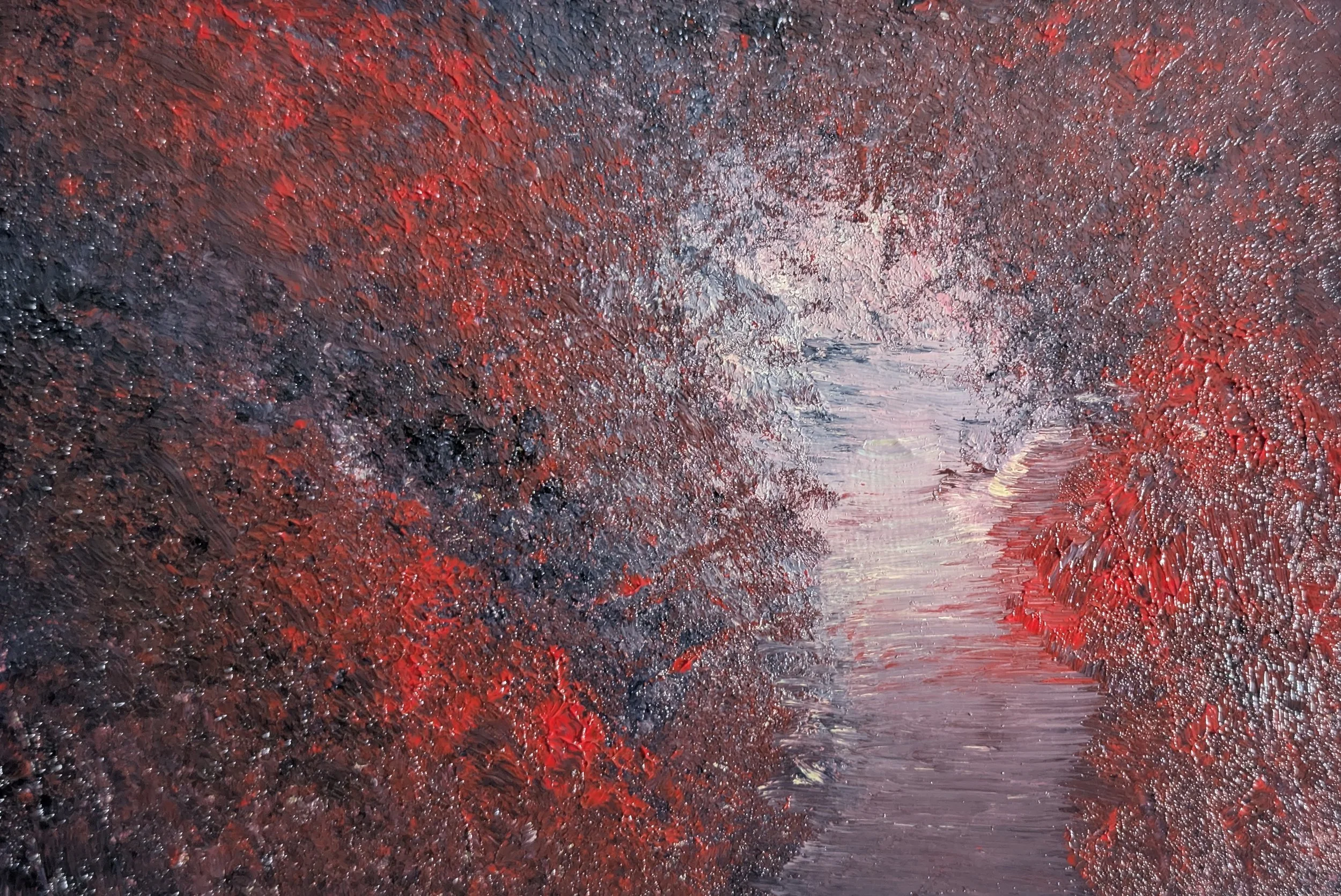
This canvas had a lot of stubborn, muddy history. After blurring out a failed study, I built up heavy masses of Payne's Grey and Alizarin Crimson, blue and red combined to make a very deep black.
3. Finding Structure (Crimson Lake in Winter)
By the third canvas, I wanted to take a more structured approach to this new technique. I brushed a cool white over the top, then used a brush to tap Alizarin Crimson along the sky's edge to form a distant shore. Realizing I needed a heavy value to pop the midground forward, I brought in Payne's Grey and used spacing to shape the landscape. When the rag couldn't give me the specific detail I wanted, I pivoted—using a stiff brush to stamp in the defined shapes of the trees.
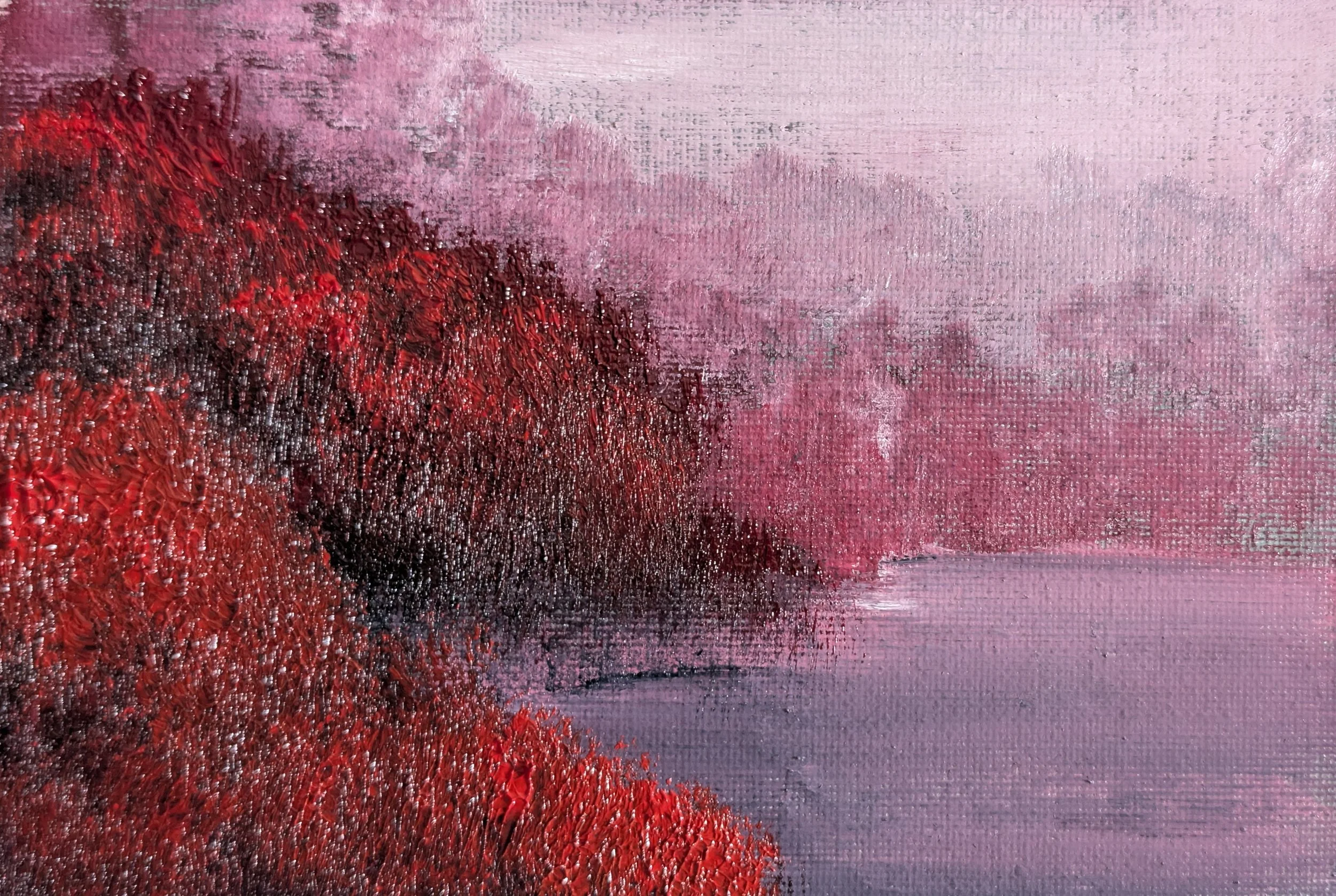
A study in atmosphere and edge control. I used a rag to fade the distant shoreline into a cool, misty sky, then switched to a stiff brush to stamp in the structural shapes of the foreground.
4. Command of Light (Thick Summer Swamp)
The final piece was the culmination of everything the first three taught me. I used the rag to establish the incredibly soft, subtle tones defining the shapes against a stark white sky. Once that atmosphere was locked in, I built the scene methodically—slowly adding each element of color, followed by crisp elements of structural detail using a stiff brush.
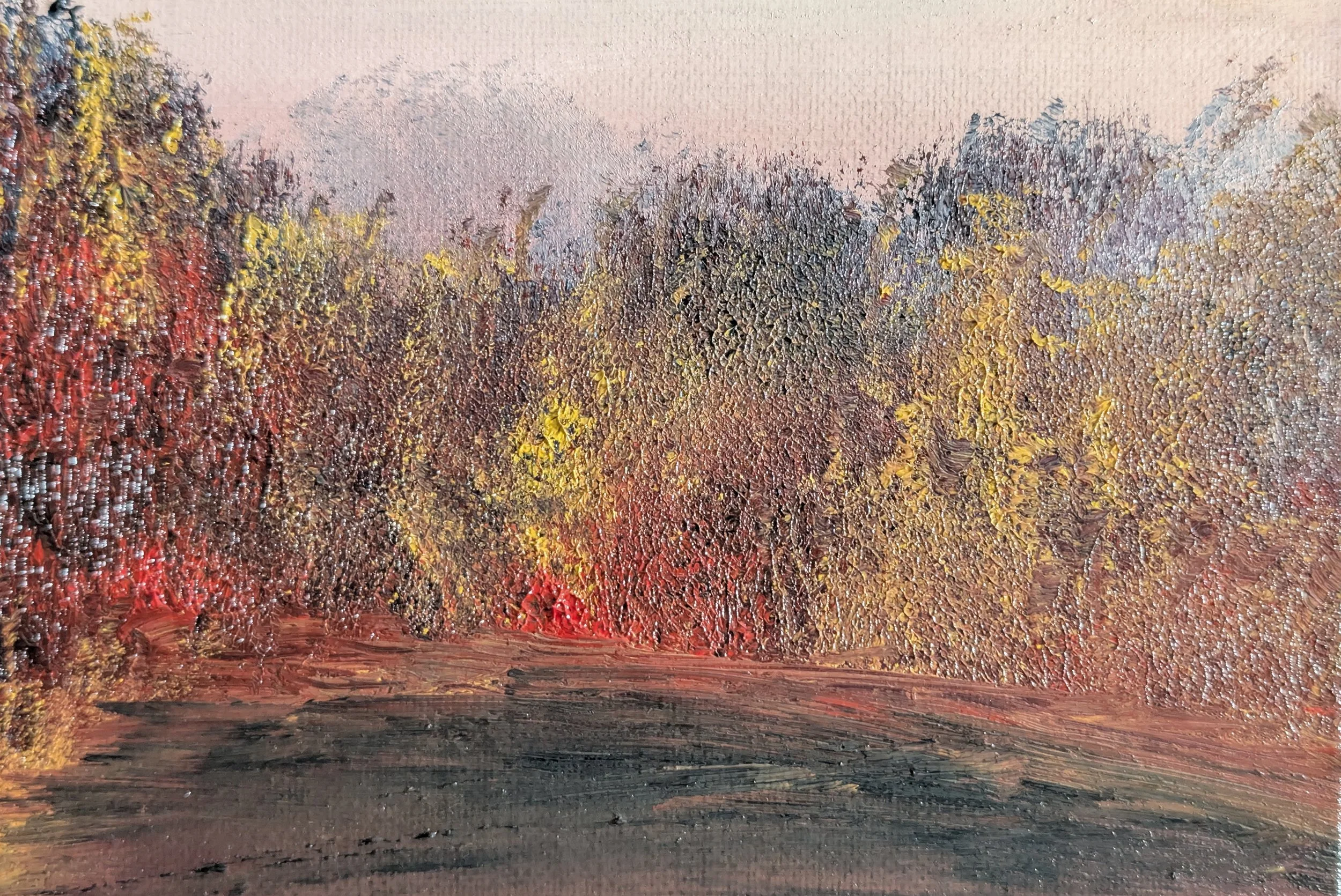
Adding the yellow orce here was a bold but necessary chose that really let the piece feel like the hot summer swamp that I was looking for.
The Lessons Carried Forward
What started as clearing away "failed" work wound up being a massive reminder of why structured play is so vital. When you eliminate the fear of ruining a canvas, you accidentally stumble into new textures, bolder marks, and deeper atmospheric depths.
These four paintings might be modest in size, but the command of light and structure they taught me is going to carry over into every large piece I build this year.
What about you? Whether you paint, write, garden, or build—when was the last time you let yourself just make a mess to see what you could discover in the clean-up?
Until next week, see you at the easel.